Hi! I actually bought the products I talk about in this post. If you want to try them, please use the link on this page to check them out. I’ll make a little money if you do. That would be awesome! You could even drop me a line via Twitter @decentmadam to let me know it was you! And then we can talk about whether you love them!
I’ve lived in the same house on and off since I was three. The major landscaping theme since the dawn of this development was Eucalyptus. First we had four on the property. Then three for the past 20 years. And now we’re down to two and eucalyptus skeleton with a tree fort in it.
What you need to know is that we’re not maintenance sort of people. We like to do flashy improvements like building a shed or re-landscaping the front yard, but can go for decades without picking up fallen eucalyptus leaves, abandoning the yard to what turned out to be as much as two feet of dead leaves, branches, and bark in some places.
Then last summer a few things happened. First, I noticed that other houses that backed the main road, like ours does, were getting their city owned fencing replaced. I knew that we were using our city fence as a sort of wall to retain or unwillingness to maintain the yard, and how freaking embarrassing would it be to have that found out? Seriously.
This fence is the original fence from when we moved in 34 years ago. I have no idea how it has survived this long. It’s about two to four feet down a small slope at the back of the yard, and over the past 34 years it has helpfully held up the annual accumulation of dead leaves, branches, and bark, plus a lot of concrete scree. I don’t actually remember how that got there. I went back to try to find out how bad this fence cum retaining wall situation was and discovered that a handyman had helpfully filled in even more dead leaves against the fence to level things out.
It was a ton of material. I needed to get it gone. So, I decided to burn some of the leaves in the barbecue to see if that would be a good way to get rid of them. And holy mini inferno batman! It went up like, well, like 35 year-old-dry leaves.
This was summer in California, so at the time there were wild fires everywhere. I hosed down the barbeque and started obsessing over researching ways to get rid of our backyard tinderbox.
It wasn’t going to fit in our green bin, that would have taken months, and California was burning, like now. I didn’t want to rent a truck and haul it away because covid. So I hosed down the leaves a bit, and went inside to do a little research.
What I landed on was composing. It would mean that I could keep the stuff on the property, make it take up less space, and make it not be a fire hazard. Apparently compost can spontaneously combust (bad!) but not if you keep it nice and damp (good!). I hauled out some 3 foot tall hogwire fencing that I had around from a previous project, assembled it into an 8 foot diameter circle, and got a drip line set up to keep my pile damp.
It took several days, many, many wheelbarrow loads, and a half-day with a specially purchased cheap electric wood chipper from Landworks to handle the dried branches and bark. Totally did the job. I love this thing. It get’s mixed reviews, but on the other hand, it’s cheap! $110 bucks as of writing this.
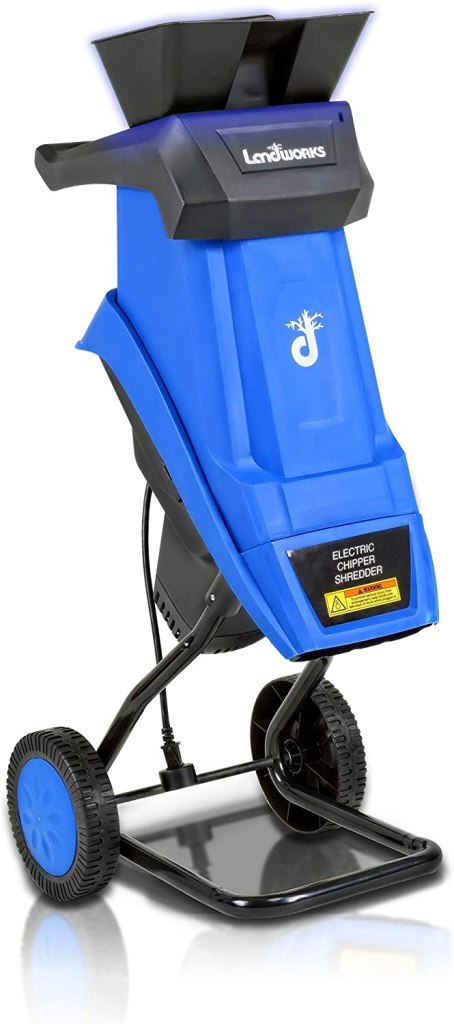
Affordable, electric, chipper/shredder. It handles our semi-annual fruit tree pruning perfectly.
What I ended up with was about 125 cubic feet of composting “browns” and a much less flammable fence line. Score! I like things easy and fast, so I added this compost starter from Jobe’s Organics, all the dog poop I could find (lots! Brown in color, but a compost green!), and an old can of dollar store coffee that no one was drinking (also a brown compost “green”).

Totally works. Hot compost in four days. Seriously.

The chair and plywood to the right were my super classy wheelbarrow ramp. Score!
So yes, I made a whole lot of compost out of eucalyptus leaves and dog poop. That happened.
The wisdom is: you probably shouldn’t do this if you want to use your compost for a vegetable garden because eucalyptus is said to have chemicals that prevent other plants from growing. And dog poop can contain pathogens that will make you sick if you eat them, say, on your vegetables.
I did it anyway. Why? Well, because it was going to make the leaves take up less room while mitigating the fire hazard. Did I mention that already? But the thing about watering and turning your horrible compost pile is that you start to get to like it, it becomes like a pet. It heated up really quickly. I credit the Jobe’s Organics compost starter, that made it so my pile was steaming hot within four days. Really. Four days.
I started to dig deeper (pun not intended, but thoroughly enjoyed) on the safety of using my horrible compost in my own garden. I learned from this SF Gate article that hot composting can maybe eradicate the allelopathic (plant killing) traits in the eucalyptus. Hot composting can also kill dog poop pathogens, and well, my murder compost is like family now, so ima go ahead and use it. I mean, does a bear shit in the woods? Or rather, does the neighbor’s cat shit in your veggie patch? That’s what I thought.
Alright, that was a bit flippant. Here’s why I’m not seriously worried about dog poo pathogens. 1) My pile was literally steaming hot for months. 2) here’s a long and detailed article about how pathogens get into our food stream. TLDR: probably not through the roots and up into the plant. Basically, wash your veggies in clean water, and you’ll probably be good. I said probably. Science doesn’t know for sure and pathogens evolve. Ima risk it.
I ended turning the pile for about 3 months, keeping it steaming hot. I ended up with a pile half the size of fine dark brown compost, twigs, and more than a handful of lava rock (I’m so glad that landscaping fad died). So, maybe 65 cubic feet of possibly murder compost. Which is a whole lot, y’all.
Here’s what I’m thinking: If it grows seeds, then I’ll use it to plant veggies in. If it doesn’t, then I’ll use it as a weed suppressing mulch under my fruit trees. Win win!
 Outdoor Hedonist
6 Comments Add yours