Hi! I actually bought the products I talk about in this post. If you want to try them, please use the link on this page to check them out. I’ll make a little money if you do. That would be awesome! You could even drop me a line via Twitter @decentmadam to let me know it was you! And then we can talk about whether you love them!
There’s a lot to love about the All New Square Foot Gardening book and method, especially if someone else starts it up for you. I did this in 2014 and it delivered as promised on everything I emphasized in my first bed. I got tired of eating lettuce and radishes though, so I let my veggie bed die and forgot about it until now.
What do you mean, “everything you emphasized?” Great question, thanks for asking! The funny thing about re-reading a book (which I did yesterday) is that you notice all the stuff you ignored the first time around. So what worked, and what did I ignore the first time? Such good questions.
The All New Square Foot Gardening, teaches a method to grow food in a small area as productively as possible with the smallest amount of effort. Although maintenance is remarkably easy, the start up is a lot of effort. If you can get someone to volunteer to do this for you, it’s totally worthwhile. If you have to do if yourself, it’s probably worthwhile too.
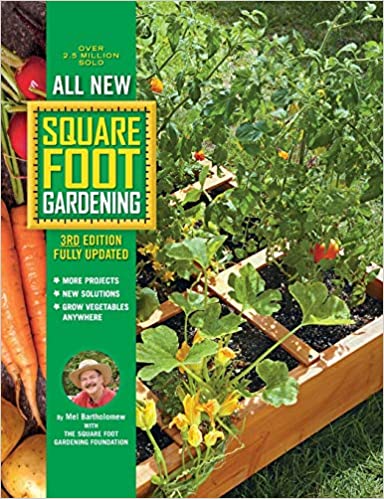
The most flowers and veggies for the least amount of effort. Perfect for Outdoor Hedonists.
Do read the book, but here’s a summary.
- Build a raised container at least 6 inches tall and no more than 4 feet wide in any direction. Narrower and taller are both okay.
- Fill your container with a mix of equal parts vermiculite (I used perlite), varied compost, and peat moss (I used coconut coir). This is called “Mel’s mix”
- Build a grid over you box to frame out 1 foot squares.
- Instead of planting seeds or seedlings in a row, plant them singly or in concentric squares inside each square foot frame depending on the recommended “thinning” on the seed packet. So each square can get for example, 1 (cabbage or broccoli), 4 (daikon radish), 9 (bush beans), or 16 (carrots) vegetables.
- When a square is done producing, only pull up that square, add compost, and replant with something else.
Like I said, this totally worked. In my garden, I planted radishes, lettuce, kale, potatoes, and carrots. We ate the lettuce and a couple radishes, ignored the kale because, I know it’s not popular, but yuck. The potatoes and carrots sprouted, grew a bit, and then died before reaching maturity. I blame external factors, not the method. We did eat the mini carrots.
The leaf lettuce went gangbusters. I planted 3 squares and by trimming the largest leaves, we got more lettuce than we ever wanted to eat, but that’s just us.
So what did I miss?
I feel like the shiniest nugget from reading through this time is to chose what you plant based on what you have in your fridge. So for us, definitely no radishes or kale. Definitely more zucchini, tomatoes, cabbage, broccoli, peas, bell peppers, you get the idea.
Other great tips:
- Replant each square when you’re done with it. I could have pulled up the rotten potato plants and put in… something else. Instead I just let it go. Same for the carrots and radishes. I had five square feet of radish, and I really should have culled those and planted something else after we didn’t eat the first square.
- You don’t have to plant everything at once. I could have planted one lettuce square one week, and other lettuce squares in subsequent weeks if we wanted them.
- Plant flowers too. If you have more squares than you want to plant with vegetables, plant some flowers to make it all prettier and attract more pollinators.
- This is pretty awesome right here: move things around. If you don’t like where a plant is growing, move it to a different square. I especially like this in combination with planting flowers.
- Build up to plant deep rooted vegetables. Last time, broke protocol and dug a trench out of my clay soil to fill with Mel’s mix and plant my potatoes. Basically, I was trying to grow potatoes in the equivalent of a clay pot with no drainage holes. Instead of digging down, Square Foot gardening says to build a small frame and place it on top of your vegetable bed.
So why do I say this method is great if someone else starts it for you? Well, starting up is heavy work. You’ve got to build a raised bed, which means prepping the area where you’ll put it, hauling and possibly cutting materials, and then fastening them together. It’s not complicated, but it is work. The real work comes when it’s time to fill it with Mel’s Mix soil blend. Blending enough vermiculite, compost, and peat moss (or coconut coir, in my case) evenly into a mix for a vegetable bed is heavy, dusty work. I spread mine out on a tarp and lifted the edges to try to mix the materials, but ended up needing to turn them with a shovel. It wasn’t so much fun for me that I’m in a hurry to do it again with another large volume of material. That said, I’ll totally mix a smaller amount to plant a tall potato or carrot planter.
Finally, I really love those little squares. They help me to understand what my plans and goals are. I’m not so interested in mixing huge amounts of Mel’s mix (although it could happen). But I would absolutely re-use many of these principles in an in-ground garden. Give me until next year and we’ll see if I change my mind and build raised beds the All New Square Foot gardening way.
 Outdoor Hedonist
One Comment Add yours