Hi! I actually bought the products I talk about in this post. If you want to try them, please use the link on this page to check them out. I’ll make a little money if you do. That would be awesome! You could even drop me a line via Twitter @decentmadam to let me know it was you! And then we can talk about whether you love them!
There’s so much to love about The All New Square Foot Gardening, and I’ve talked quite a bit about the pros and cons of using this method for my own garden.
The most flowers and veggies for the least amount of effort. Perfect for Outdoor Hedonists.
This time around, I’m pulling my favorite elements from the book, and applying them to my latest veggie patch.
What were some of these elements?
- Loose, workable soil
- framed planting squares
- plant what you eat
- pull up what no longer serves you
Soil
My soil is not ideal for veggie gardening. It’s hard packed clay, and the only things that grow reliably in it are weedy grasses. Prolifically. I don’t want to fight those weedy grasses more than necessary, and I don’t want to try to till my clay, so I set my compost directly on top of my soil. Maybe it’ll work? Maybe it won’t. The details are in an earlier post, but my main concern was whether my new garden would be plant friendly or deadly.
I ran some tests and while there’s room for improvement, I did find that my compost is perfect for germinating seeds. That gives me some time to make those improvements by way of nitrifying plants and more nutritious compost. The important part is that it’s loose and easy to work with, and not so deep that clay loving plants will have trouble anchoring themselves into the heavier soil.
Framed Planting Squares
A frame over a veggie patch is the defining image of Square Foot Gardening. The author goes so far as to say that if it doesn’t have a grid, it’s not Square Foot Gardening. I’m not so sure that having a grid is enough for it to definitely be square foot gardening, but there’s a lot to love about this method.
- I can know exactly where I planted my seeds. I mean exactly. I can easily tell whether a seedling is my seed coming up or a weed, just by where it’s located.
- It has crop rotation built into the method. Plant one type of plant per square. Put that type of plant somewhere else next time. Don’t plant the same plant in two adjoining squares. Plant something different when your plant is done. Easy.
Basically, it’s defined, concise, and requires very little advanced planning. And if you mess it up, you can just move things around.
Plant What You Eat/ Pull Up What No Longer Serves You
This idea is so awesomely obvious that I want to shout it from the rooftops. I ordered a mixed seed packet from Home Depot full of what veggies I’ve got in the fridge. It’s the most affordable way I’ve found to purchase a variety of seeds. Best part is, if I’m producing more of one veggie than we can eat, I can just pull up one or more squares and plant something else.
I used to get a thrill out of loading a ton of materials into/onto my bright yellow mini cooper. It was worth it for the looks, and the dusty men in paint stained pants running over to try to help. What? Simple pleasures. Sue me.
These days who wants to go out and breathe heavy around people? Nope. A quick hunt around the yard turned up enough recovered 1X2 pine board to frame out the patch. This is part of the same project that yielded the hogwire for the compost pile. I love it when reusing is the laziest way of doing a project.
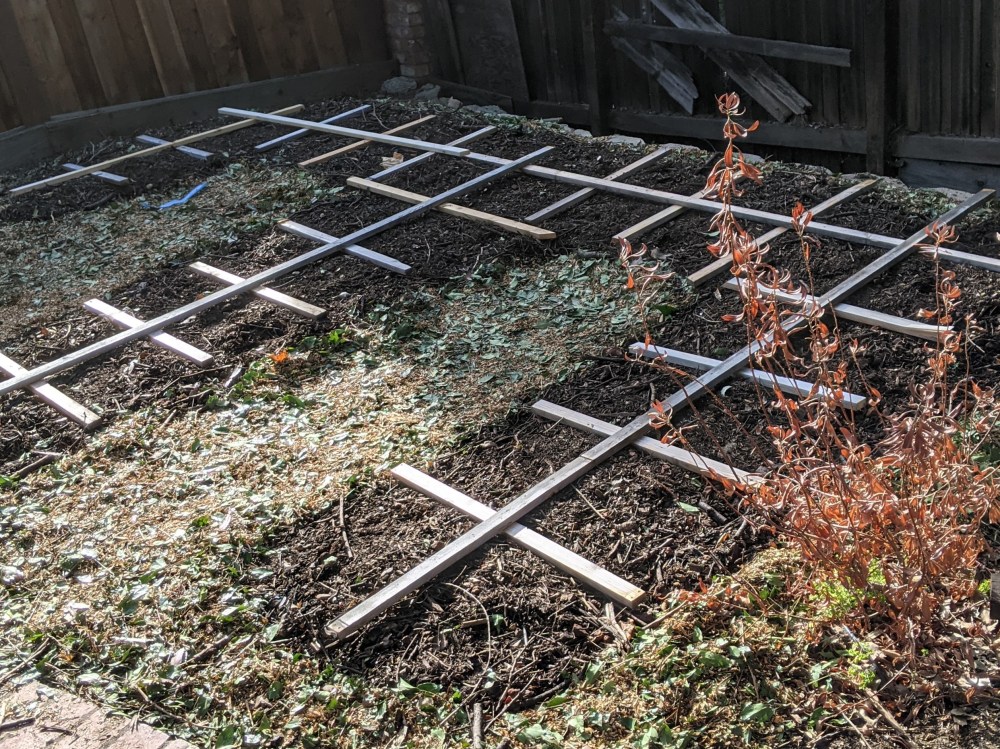
Ima go ahead and invoke family motto #1 here: perfect is the enemy of done. I didn’t measure the squares. I eyeballed them, and framed them in relation to the veggie patch, which is not a perfect grid. Motto #2: Key to happiness? Lower expectations.
 Outdoor Hedonist
One Comment Add yours