I’m just going to come out and say this: I’m afraid of chemical fertilizer.
It doesn’t have to make sense. It just is.
There are so many uncertainties about the stuff. Like, if I measure it out and mix it like the label says, can I then just dump it all in one spot? What if I pour a little too much into one area? Doesn’t that stuff explode? You’ve got to, like, measure the fertilizer, measure the water, measure the area you’re fertilizing, make calculations, and then try to apply an even amount over the area. That’s way too not lazy enough for me.
I’m totally not googling this to fact check it because I don’t want to fall down that rabbit hole, so take the following with a bucketful of salt. Here’s what I worry can happen from incorrectly applying chemical fertilizer (mini neurosis activated): I might burn my plants, poison my soil, risk chemical burns, and/or (probably not highly likely) cause an explosion. I’m so averse to this stuff that I don’t go near it even though we actually have it around the house. There is literally an old bag of citrus fertilizer sitting right next to a nutrient starved lime tree, in my back yard, right now.
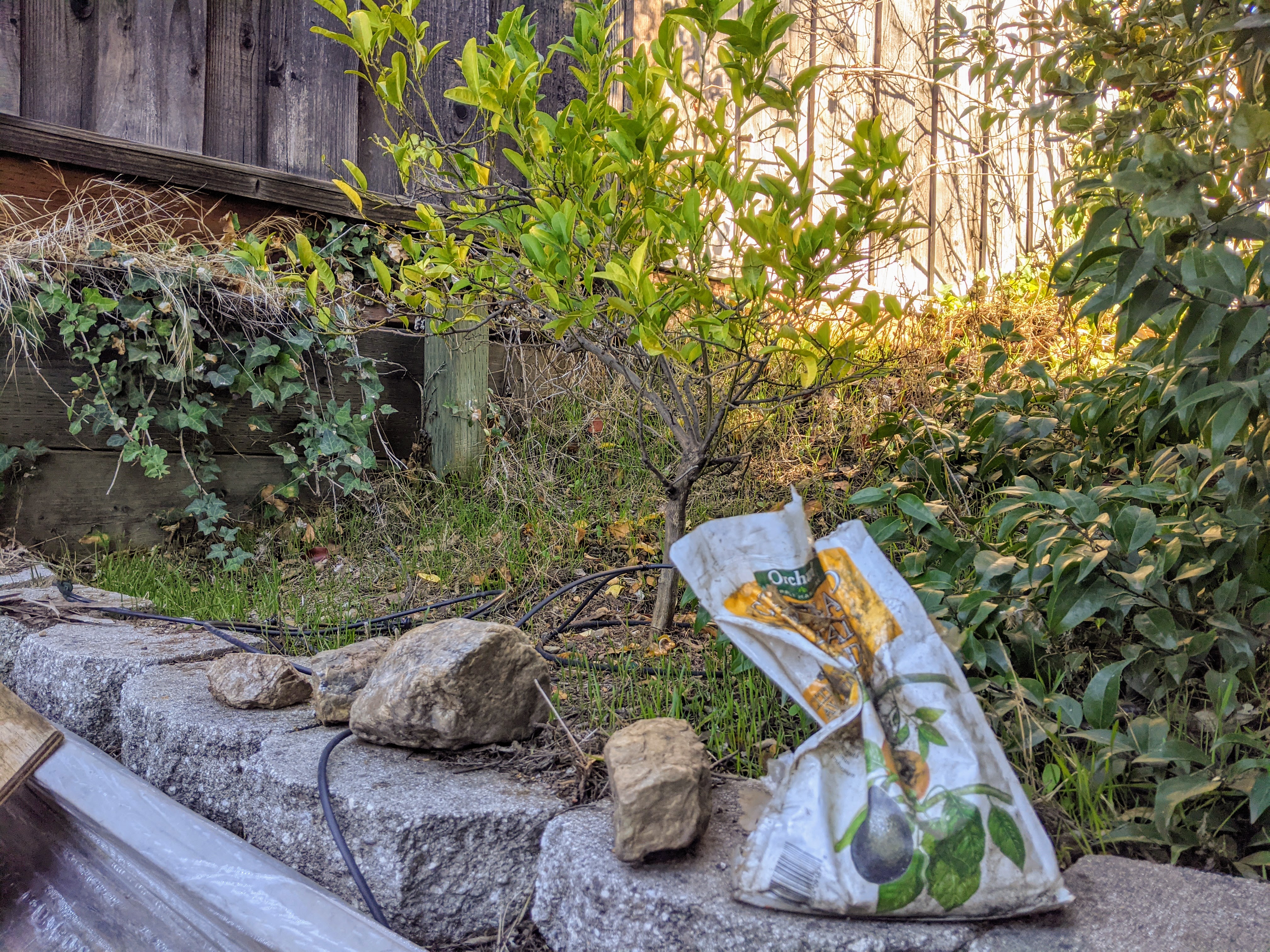
Avoiding all these consequences is work, and I like lazy solutions that don’t involve going to a store, even if they can also sometimes explode, or spontaneously combust, or whatever. Apparently compost can do that.
I mentioned it doesn’t have to make sense, right? (okay, mini neurosis deactivated).
My instinct is to rely on organic fertilizers that I can make at home, like compost and seed meal that. Because they’re so much less concentrated than synthetic fertilizer, using too much isn’t going to cause any injuries. And you don’t have to carefully measure them. But if you’ve read my murder compost and seed meal posts, you’ll know that this isn’t actually going all that well for me; the murder compost has no nitrogen, and neither does the seed meal. And enough nitrogen for your plants is the difference between a vibrant green garden and a scraggly yellowing one.
Plants use nitrogen to make chlorophyll. Chlorophyll is the green pigment in plants, and also what they use to convert sunlight to energy so they can grow. If they don’t get enough nitrogen, plants literally can’t make enough green pigment to grow efficiently, because they’re not converting sunlight well.
There are two other macronutrients besides nitrogen: phosphorus, and potassium (or potash), that are majorly important to plants. This is why fertilizers list something called N-P-K, for nitrogen, phosphorus and potassium (AKA ‘potash’ chemical symbol K). But nitrogen is a challenge for the home gardener because we like to make compost, and the microorganisms turn leaves and food scraps into compost use up nitrogen as a food source. So at some point, we’re probably going to have to buy soil additives high in nitrogen.
There are definitely organic fertilizers that are high in nitrogen.
Cow, horse, or chicken, manure, urine (I shit you not), earthworm castings, basically anything that has gone through an organism is going to be high in nitrogen. These solids are great to use when you’re preparing a vegetable bed or planting plants, because you can mix them into the soil to add nutrients and organic material that will help both retain moisture, and drain excess water.
As an avowed fertilizer phobic, I’m a little hung up on how to get nitrogen into my seed starts. The usual suggestion is to buy a liquid plant food (fertilizer) and get those nutrients in when you water. Just going to point out that only one of the nitrogen sources on the above list comes in liquid form, and some people absolutely do apply human urine to their plants. Who am I to judge? I’m not going down that path at the moment (although, *taps chin* it does seem extremely lazy). So that definitely means that a purchased fertilizer plus some measuring and mixing is in order…
I guess I can go practice with that old bag of citrus fertilizer.
 Outdoor Hedonist
One Comment Add yours